What Is Moringa? The Nutrient-Rich Leaf Explained
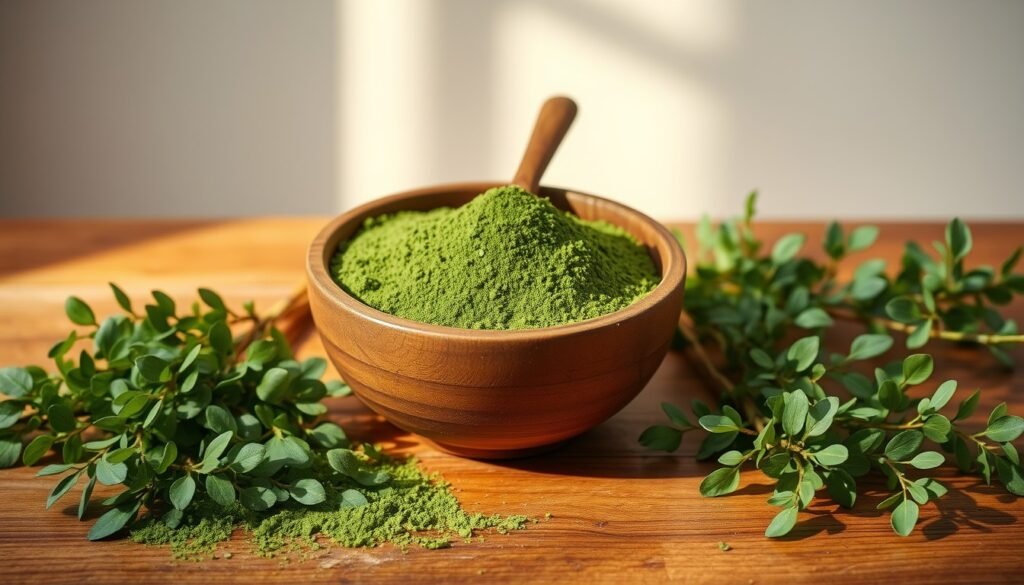
Moringa is a fast-growing tree, Moringa oleifera, whose small green leaves are eaten fresh, cooked like spinach, or dried and ground into powder. In 100 g of fresh leaves, the United States Department of Agriculture’s food database lists 9.4 g of protein, 185 mg of calcium, 4.0 mg of iron and 51.7 mg of vitamin C. This page explains what moringa is and shows everything that is in the leaf.
Key takeaways
- Moringa is a fast-growing tree from the foothills of the Himalayas. Its leaves are eaten fresh, cooked or as powder.
- Fresh leaves hold 9.4 g of protein in 100 g, about three times as much as spinach or kale (USDA).
- Powder is richer by weight because the water is gone, but a serving is only about 3 to 4 g, and labels differ (USDA label records).
What is moringa?
Moringa is a tree from the foothills of the Himalayas, in northern India, Pakistan and Nepal (2015 review). It grows fast: about 3 metres in three months, and up to 12 metres tall (2015 review). Today it is grown in tropical and subtropical countries, in many kinds of soil, including poor ones.
It goes by several names. Drumstick tree comes from its long, slender seed pods, horseradish tree from the taste of its roots, and in the Philippines it is called malunggay (Wikipedia).
The leaves are the part people use most, but the flowers, seeds and young pods are eaten too (2021 review).
What nutrients and vitamins are in moringa leaves?
These are the amounts in 100 g of fresh, raw moringa leaves, measured by the United States Department of Agriculture (USDA), which lists them as “drumstick leaves”.
| What | In 100 g of fresh leaves | Source |
|---|---|---|
| Protein | 9.4 g | USDA |
| Fibre | 2.0 g | USDA |
| Calories | 64 | USDA |
| Vitamin A | 378 µg | USDA |
| Vitamin C | 51.7 mg | USDA |
| Vitamin B6 | 1.2 mg | USDA |
| Riboflavin (vitamin B2) | 0.66 mg | USDA |
| Niacin (vitamin B3) | 2.22 mg | USDA |
| Thiamin (vitamin B1) | 0.257 mg | USDA |
| Folate | 40 µg | USDA |
| Potassium | 337 mg | USDA |
| Calcium | 185 mg | USDA |
| Phosphorus | 112 mg | USDA |
| Magnesium | 42 mg | USDA |
| Iron | 4.0 mg | USDA |
| Manganese | 1.063 mg | USDA |
| Zinc | 0.6 mg | USDA |
The same record lists 18 amino acids, the building blocks of protein. All nine that the body cannot make itself are among them (USDA).
How does moringa compare with spinach and kale?
Here are 100 g of each, raw, from the same database: moringa leaves, spinach and kale.
| What | Moringa leaves | Spinach | Kale | Source |
|---|---|---|---|---|
| Protein | 9.4 g | 2.86 g | 2.92 g | USDA |
| Calcium | 185 mg | 99 mg | 254 mg | USDA |
| Iron | 4.0 mg | 2.71 mg | 1.6 mg | USDA |
| Potassium | 337 mg | 558 mg | 348 mg | USDA |
| Magnesium | 42 mg | 79 mg | 33 mg | USDA |
| Vitamin C | 51.7 mg | 28.1 mg | 93.4 mg | USDA |
| Vitamin A | 378 µg | 469 µg | 241 µg | USDA |
| Vitamin B6 | 1.2 mg | 0.195 mg | 0.147 mg | USDA |
| Calories | 64 | 23 | 35 | USDA |
Weight for weight, moringa leaves hold about three times the protein of spinach or kale, and more iron and vitamin B6 than either (USDA). Kale holds more calcium and vitamin C, and spinach holds more potassium, magnesium and vitamin A (kale, spinach).
One reason for moringa’s lead is water. Its leaves are about 79% water, against about 91% for spinach and 90% for kale, so there is more leaf in every 100 g.
Does cooking change what is in the leaves?
Yes. Weight for weight, boiled and drained leaves hold less of most things than raw leaves (USDA, boiled leaves).
| What | Raw, 100 g | Boiled and drained, 100 g | Source |
|---|---|---|---|
| Protein | 9.4 g | 5.27 g | USDA |
| Calcium | 185 mg | 151 mg | USDA |
| Iron | 4.0 mg | 2.32 mg | USDA |
| Potassium | 337 mg | 344 mg | USDA |
| Vitamin C | 51.7 mg | 31.0 mg | USDA |
| Vitamin A | 378 µg | 351 µg | USDA |
What is in moringa powder?
Moringa powder is the dried leaf, ground. Drying takes the water out, so powder is richer by weight than fresh leaves. One published table puts dry leaf powder at 27.1 g of protein in 100 g (2021 review).
A serving is small, though. Two brands’ labels in the USDA’s records both give a serving as 2 teaspoons, about 3 to 4 g, with 15 calories and 1 g of protein (first label, second label).
There is no official record for moringa powder, and labels differ. Those same two labels list 4.8 mg and 0.18 mg of iron in a serving. So the numbers on one label do not tell you what is in another.
Does moringa have seven times the vitamin C of oranges?
You will see that line on many moringa pages. Fresh for fresh, the USDA lists 51.7 mg of vitamin C in 100 g of moringa leaves and 53.2 mg in 100 g of oranges (moringa leaves, oranges). That is about the same, not seven times as much.
Another line says moringa has 92 of them. We could not find a measured source for that count, so this page does not repeat it.
How do people eat moringa?
The fresh leaves are cooked like spinach. In the Philippines and Indonesia they go into broth soups, and in South Asia the young pods, called drumsticks, go into curries, soups and dals (Wikipedia).
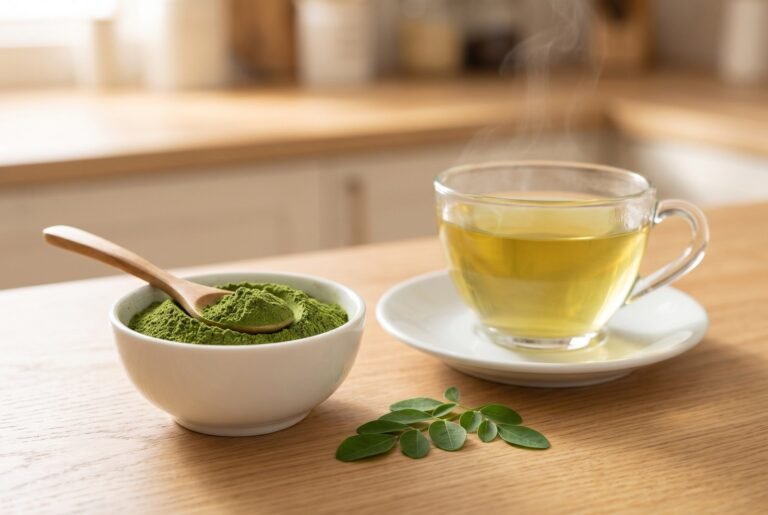
Powder is the easy way to use the leaf where fresh moringa is hard to find. Stir about half a teaspoon into water, a smoothie, yogurt or oatmeal, and adjust to taste. It tastes fresh, grassy and gently earthy.
Common questions
Does moringa have protein?
Yes. The USDA lists 9.4 g of protein in 100 g of fresh moringa leaves.
Are moringa leaves the same as drumstick leaves?
Yes. Drumstick tree is another name for moringa, and the USDA lists the leaves as "drumstick leaves".
Which parts of moringa are eaten?
The leaves are used most. The flowers, seeds and young pods are eaten too (2021 review).
What does moringa taste like?
The leaf tastes fresh, grassy and gently earthy.
Does moringa have caffeine?
No. Moringa leaf has no caffeine.
Sources
- United States Department of Agriculture, FoodData Central, "Drumstick leaves, raw" (record 168416). fdc.nal.usda.gov
- USDA FoodData Central, "Drumstick leaves, cooked, boiled, drained, without salt" (record 168417). fdc.nal.usda.gov
- USDA FoodData Central, "Spinach, raw" (record 168462). fdc.nal.usda.gov
- USDA FoodData Central, "Kale, raw" (record 168421). fdc.nal.usda.gov
- USDA FoodData Central, "Oranges, raw, all commercial varieties" (record 169097). fdc.nal.usda.gov
- USDA FoodData Central, branded foods, "Moringa powder" (record 2410355, a brand's own label). fdc.nal.usda.gov
- USDA FoodData Central, branded foods, "Moringa powder" (record 2429471, a brand's own label). fdc.nal.usda.gov
- Leone and others (2015), "Cultivation, Genetic, Ethnopharmacology, Phytochemistry and Pharmacology of Moringa oleifera Leaves: An Overview", International Journal of Molecular Sciences 16(6):12791-12835. pmc.ncbi.nlm.nih.gov
- Islam and others (2021), "Moringa oleifera is a Prominent Source of Nutrients with Potential Health Benefits", International Journal of Food Science 2021:6627265. pmc.ncbi.nlm.nih.gov
- Wikipedia, "Moringa oleifera" (common names and dishes). en.wikipedia.org
Researched and checked by the Namcovi Naturals team on November 13, 2026.
Have a question about this post?
Ask us and a real person will answer.